

Is it possible to be critical of Israel without being antisemitic?
I am reminded of this clip of a former friend of mine, Rod Dreher, being interviewed by Jeremy Boering, in which they both agree that it is theoretically possible to be critical of Israel without being an antisemite, but they also paradoxically agree that everyone who criticises Israel is an antisemite.
Anyone with an ounce of critical thinking can see the Kafkaesque trap here:


In this article, I have no intention of criticising Israel. I am merely posing the thought experiment to my learned readers: Is it possible to be against Benjamin Netanyahu, his administration and their political policies, without being branded as an antisemite? And if so, where is the line?
I ask because I am not sure there is a distinction in many people’s eyes.
So-called Christian Zionists have a theological reason to favour Israel. In their religion, the 1948 state of Israel is the Israel of the Bible. It is a very novel idea, mostly propagated by Scofield and Darby, but I do not want to go off on an anti-’Christian Zionist’ tangent. The point being, one can almost understand their blind allegiance, however much in error they are.
However, even secularists/athiests often seem to have a visceral response to any criticism of Israel.
Responses to even the mildest public criticisms of Israel usually come in the form of “Disgusting!” “Antisemite!” “What happened to you?” or “You’ve changed!”
Note the highly effeminate, strong emotive language of disgust and empty accusations of having somehow changed. The above exclamations are increasingly common, as are accusations of going “beyond the pale,” which suggest there is an obvious line in the sand that people understand we cannot cross, and that crossing it breaks an unwritten social taboo. Criticising Israel is almost blasphemous, even to the irreligious.
I suppose a lot of this comes down to the post-World War II liberal consensus. The idea that the worst thing that has happened in modern history is the Jewish Holocaust, and we must do all we can to prevent it from happening again. I would argue it is not, by the way; the number of innocent babies killed in abortions since their decriminalisation in the 1970s is the greatest evil in modern history, but I am not here to compare evil acts.
We can all agree that the systematic extermination of any group of people is evil - I am not the biggest fan of Islam, but I have repeatedly spoken out against the extermination of Uyghurs in China - Whatever number of Jews were killed during WWII is too many. As is the 6 million Poles who were killed, for whom he went to war in the first place to protect. Around half a million Britons were killed too, and nearly as many Americans. We should mourn all their deaths, and prevent future brother wars at all costs. Europeans fighting Europeans is abominable.
We can agree with all of this, and still be critical of Israel, without wanting to see a re-run of the latter half of WWII.


Part of the problem has to be the conflation between state, people, and religion. Israel, the state set up in 1948; the Israeli people; and the modern religion of Judaism. ‘The Jews’ can be used to describe all three, and is therefore a clumsy and unhelpful descriptor.
But then, people often claim it is not the words themselves that are the issue, but the tone in which they are used. I have always found this to be a lazy argument used to shut down free speech. It usually means there is technically nothing wrong with the words being used, but the person taking offence simply does not like them being used. When one sinks down to the level of policing tone, one has already lost the argument. Tone is subjective; quite a lot can rely on inference. People bring their own prejudices to how they read a statement and may make assumptions about something that was not implied by the writer but is inferred by the reader.


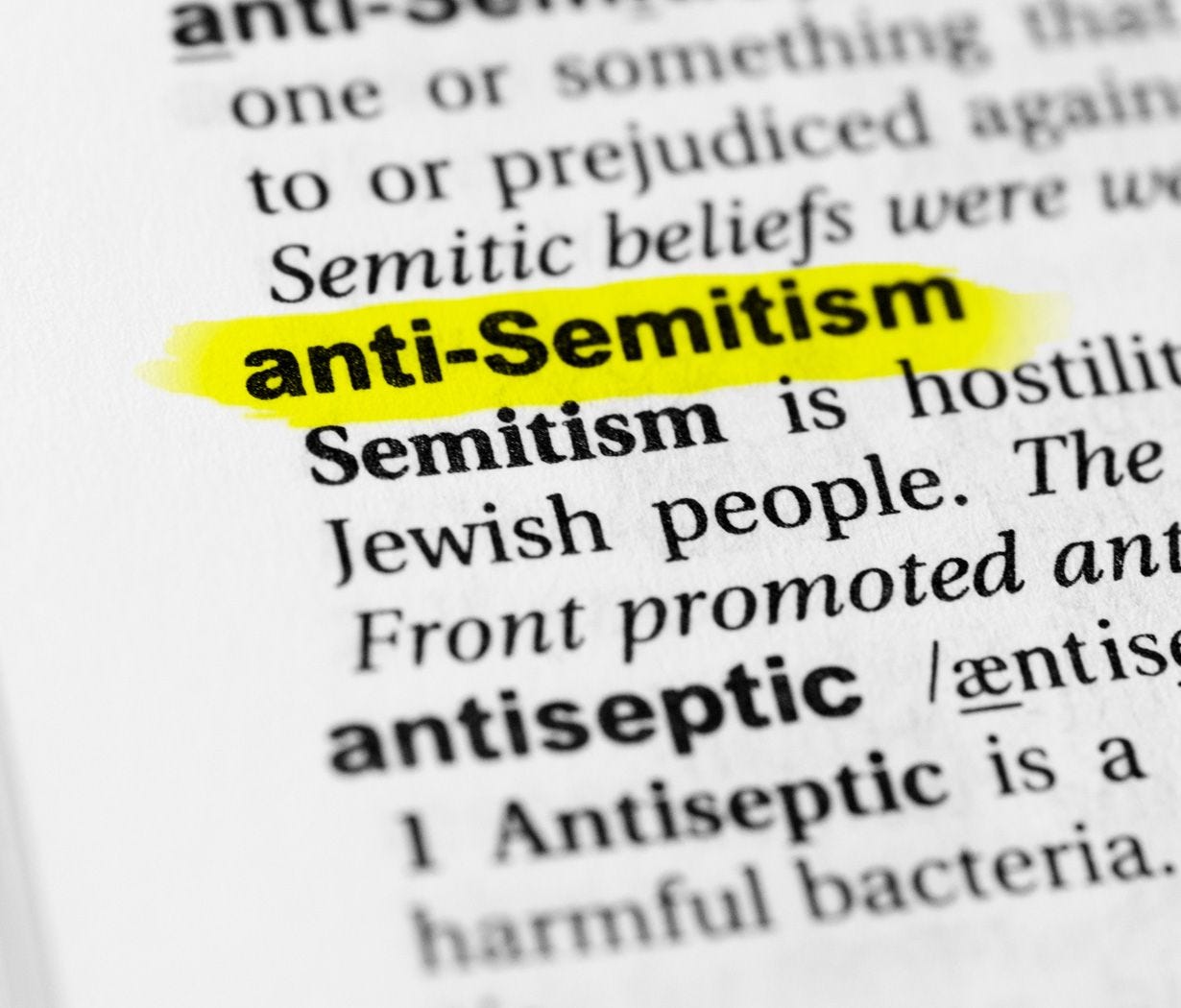
We should define terms. What is antisemitism? There are far too many shifting definitions, from “disagreeing with the right of the Jewish people to have a homeland,” to “disagreeing with the right of Israel to defend itself”, to “the hatred of the Jewish people.” Let us stick with the latter. The original Merriam-Webster dictionary definition: “Opposition to, or hatred of, Semites, especially Jews.” Note that the Oxford Dictionary originally refused to use the word, and the Encyclopædia Britannica would only define it with caveats.
If you want to see an example of woke in practice, look up the very broad definitions from IHRA, JDA and Nexus.
Again, it is a clumsy and unhelpful word, probably by design. Shifting definitions is a mechanism used by bad-faith actors in an attempt to win arguments.
Not long before he was executed, Charlie Kirk said, “You’re not allowed to criticise Israel.”


So, all things considered, is it possible to be critical of Israel without being antisemitic? If so, where is the line - who gets to draw it and why?
I look forward to reading your feedback on this one. Try to keep the arguments in good faith.

Yes. So too can an American be critical of America, without being unpatriotic.
Of course you can! I do quite a lot and I’m a Zionist.