

The Christian faith is sacrificial. St John calls Jesus the Lamb of God to signify the typology at play. In the Old Covenant, the people of God sacrificed lambs in the Temple. In the New Covenant, the sacrificial lambs have been replaced. Christ died on the cross for us; He offers Himself as the ultimate sacrifice that we were unable to pay for our sins. The Mass quite literally replaces the Passover in that way, as families of the faithful gather together to commemorate not the Exodus from Egypt over a sacrificed lamb, but to commemorate Christ’s perpetual sacrifice for us, for our redemption, that we gain eternal salvation.
Abraham was asked to bind his son, Isaac, and offer him up as a sacrifice. Abraham passed the test, showing his sincere faith in God by offering up his son on the altar, but an angel prevented him at the last minute. Again, the typology is clear, and in place of Isaac and the rest of us, God the Father offers up His only begotten Son instead.
The Temple was destroyed in 70AD for that reason. We are the new temple. Christ said to Peter, “On this Rock I will build my Church.” That Rock is literally Peter, the first Pope, but that rock is also Peter’s faith in Christ, and more importantly, that rock is also Christ. Christ as the cornerstone, on which our faith is built. Christ Himself, and Christ’s servants, and Christ’s body - the Church - are all the new Temple. There will be no ‘third temple’ for that reason. We receive the gifts of the Holy Spirit through the Sacraments of Baptism and Confirmation, and we receive Christ’s Body and Blood in the Most Blessed Sacrament of the Altar. And so we are, spiritually, really and presently, temples for God.
Likewise, the priest class was replaced. Gone are the corrupt Pharisees and Scribes. The Church institutes deacons, presbyters, and bishops for the purposes of ministering to the faithful and administering the sacraments. In other words, to celebrate the sacrifice. Christian ministry is sacrificial in that way.
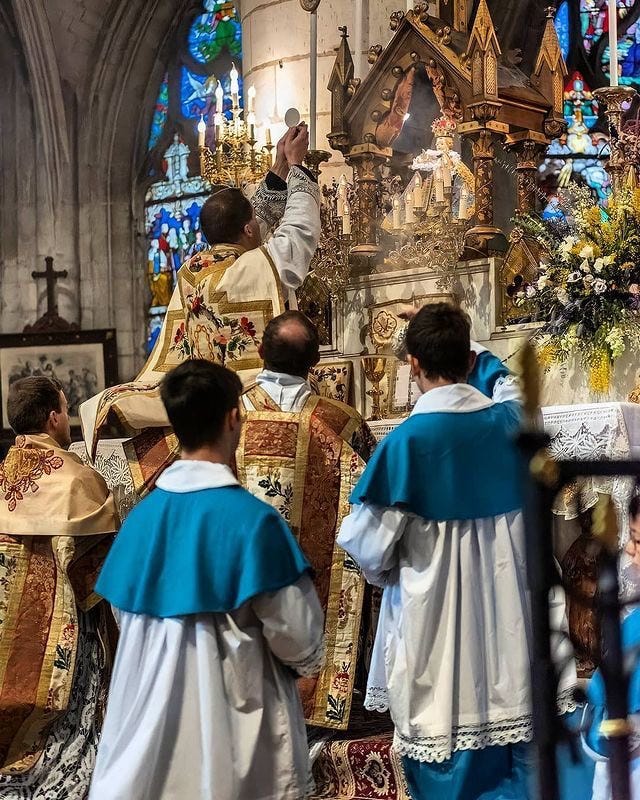
Jesus is crucified once and for all. And the Mass is the blessed sacrament by which we enter Calvary, and as a congregation gathered together in His name, we are joined with the Communion of Saints in an act of true worship, as the priest at the altar removes himself, dons the sacred vestments as an unworthy servant (“quam ego indignus fámulus tuus óffero tibi”), and takes the place of Christ, offering up the oblations to the Father. In that moment, heaven and earth are joined - the parish and the choir of angels are one in praise and worship of the one true living God (“Deo meo vivo et vero”). “Súscipe, sancte Pater, omnípotens aeterne Deus”, says the priest, addressing God the Father, “hanc immaculátam hostiam,” offering up an unspotted and immaculate victim; the hostiam or host, is the sacrificial offering, preparing for the spotless Lamb of God as the bread is about to become the true Victim.
The offering is propitiatory, “pro innumerabílibus peccátis, et offensiónibus, et negligentiis meis,” offered for the sins of the priest, and the sins of the congregation, “et pro ómnibus circumstántibus, sed et pro ómnibus fidélibus Christiánis vivis atque defunctis.” The Mass is offered for both the living and the dead. Christ’s passion and resurrection is enough for all. All of this is for our final purpose, eternal salvation, “ut mihi, et illis proficiat ad salútem in vitam aeternam.” The ultimate sacrifice.
All this to say, Christians have always known we are a faith of sacrifice. The ultimate sacrifice of the only begotten Son of God, for us. But also our own personal sacrifices, as we are called to pick up our own crosses and follow Him to Calvary, metaphorically as we suffer through life and are formed and sanctified by His Grace, but also literally as we attend the Mass. It is for this reason that Catholics have always taught that the Eucharist (the Holy Sacrifice of the Mass) is "the source and summit of the Christian life."
Protestantism denies the sacrifice of the Mass as a core tenet, and the Novus Ordo undermines the sacrifice. Bear with me on the latter, whilst we address the former.
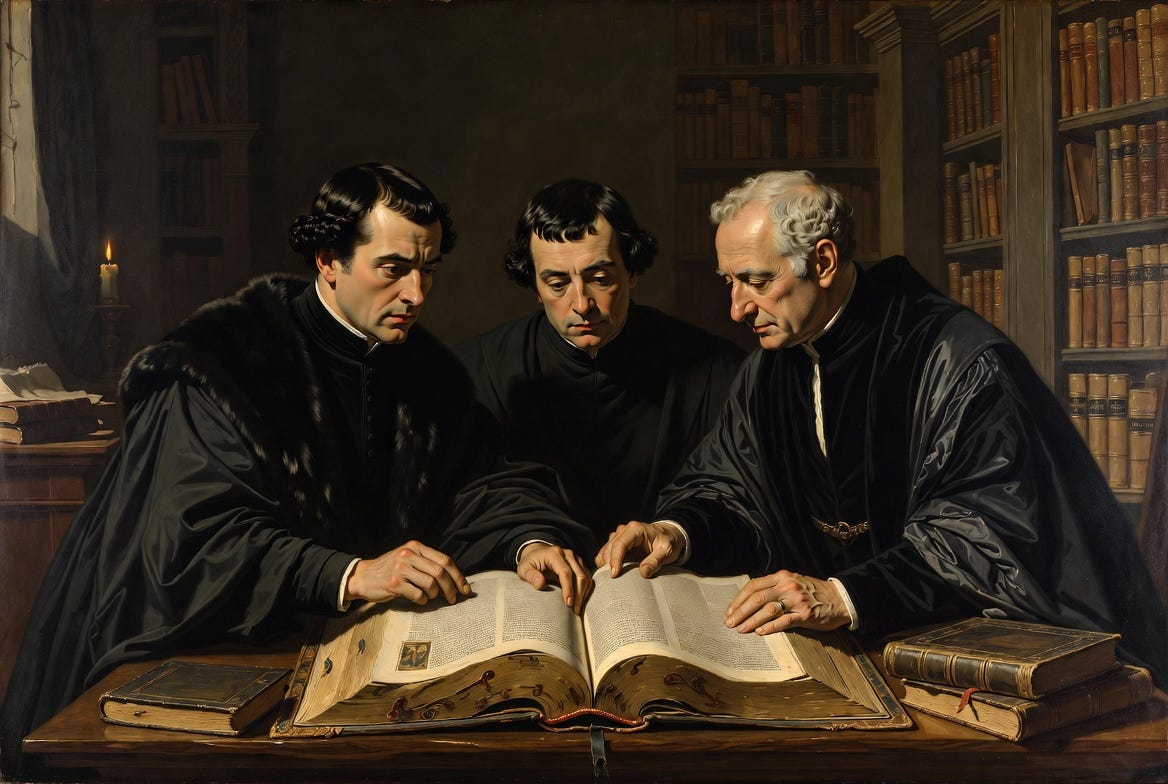
The reason Pope Leo XIII declared Anglican Holy Orders “null and void” was that all sacrificial language was removed from the Ordinal in the Book of Common Prayer - the liturgy used to ordain clergy in the Church of England. Without explicit sacerdotal language, the Holy Father deemed there to be a defect of form and intention. This was no accident. Martin Luther, Huldrych Zwingli, and Thomas Cranmer all worked to remove the sacrificial offerings from the formula of the Mass. The Canon was stripped by design to undermine the teaching of the Real Presence.
If one considered that the enemy does not want us becoming living temples of God, one might assume he wants us to no longer receive the Body and Blood of Christ. How might he go about convincing us to no longer do so? By implicitly teaching us that the bread remains bread, the wine remains wine, and there is no more sacrifice. I put it to you that this theology is empty and leads people toward death. Without the Holy Eucharist, there is no health in us. Christ Himself is the gift of Life (Romans 6:23, John 14:6, 1 John 5:11–12).
The reason for bringing this up is not to disparage my separated brethren in Christ, but to encourage all Christians to focus on the sacrifice and return to the Sacraments, as a matter of salvation. You have been robbed of your inheritance.
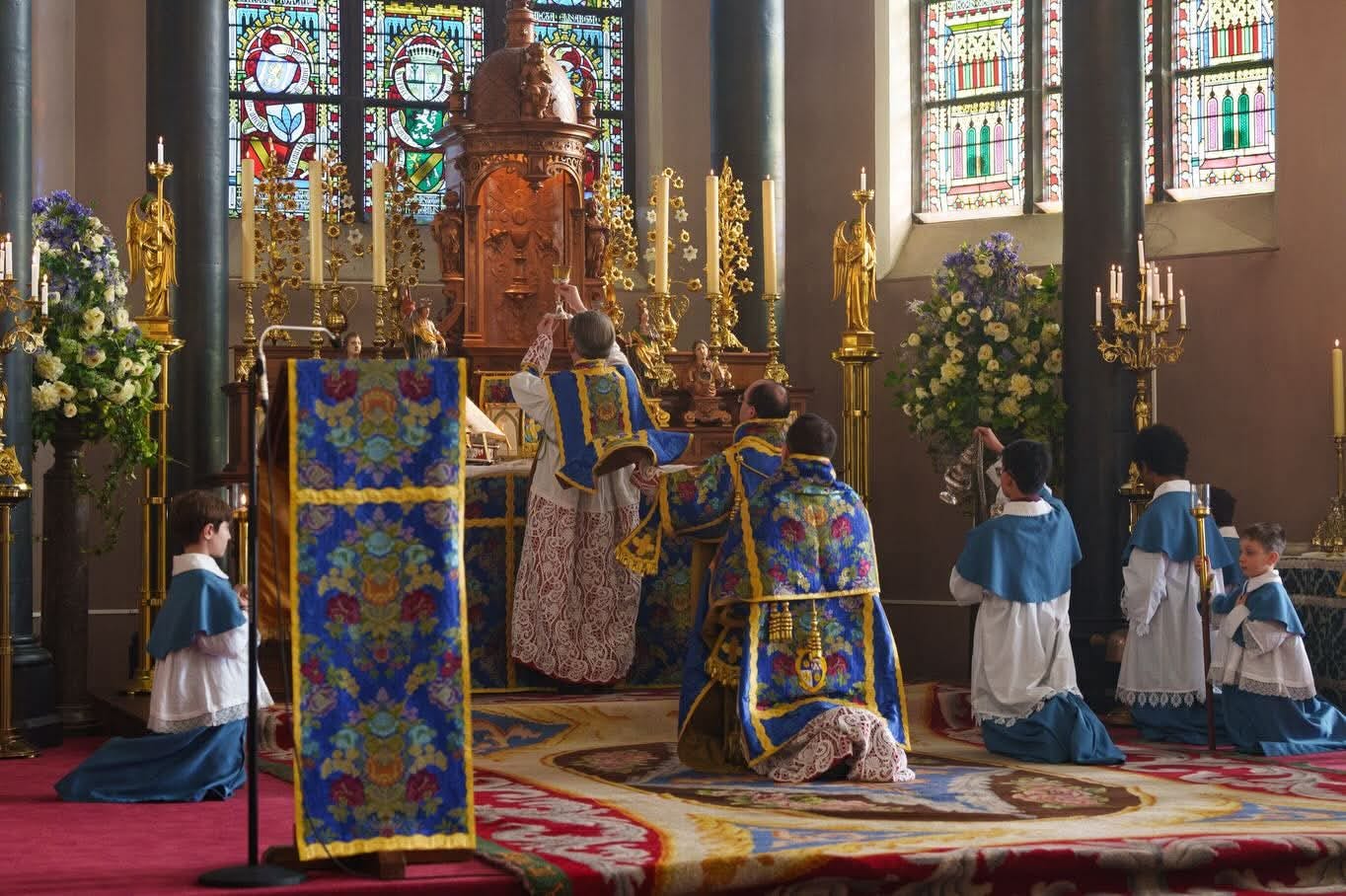
As for the Novus Ordo, much like the Protestant Reformation, where the Canon of the Mass was stripped, this time the Offertory prayers were changed. The sacrificial language we quoted earlier was removed, and in its place Jewish bread-breaking prayers were added. The Mass was also moved from the High Altar to a table in the nave. This is not inconsequential. Instead of a priest offering up the oblations on an altar toward God, on behalf of his congregation, instead, Rabbinic meal blessings are said around a table, facing the congregation. The Holy Sacrifice of the Mass has been turned into nothing more than a Jewish meal. Is it any wonder the vast majority of Catholics polled no longer believe in the Real Presence of Christ? Why would you believe Jesus is truly present in the sacrifice when you no longer witness a sacrifice, and instead a little old lady hands you a piece of bread to eat? As lovely and well-intentioned as these little old ladies are, “Extraordinary Eucharistic Ministers” are neither extraordinary nor necessary. The priest’s hands are consecrated with holy oils for the purposes of administering the Sacraments. It is another ploy of the enemy to persuade people that there is some need for lay women - and it is primarily women - to defile the blessed host in this way. Each small step further dilutes the faith of your average Catholic.
Removing altar rails, preventing kneeling in reverence, encouraging ‘active participation’ and use of the vernacular all seemed like small and benign changes, but over time they have led to the dancing and prancing around that we see in many modern N.O. churches today.
To Christians, we are the new Israel - the spiritual Israel - the Church is a continuation of God’s chosen people. The Old Testament points toward the coming of Christ, and the New Testament speaks of His fulfilment of the old prophecies and promises of God. No one is replaced, but everyone is welcomed in. The Jews who followed their Messiah - the Christ - became members of the Church, and the Gentiles who joined them were grafted in. This is a marvellous gift our Lord has given us.
Fast forward a few hundred years, and a few of the people who rejected Christ attempted to reclaim their old faith. Modern-day Judaism is not the same as the Judaism of the Bible. There is no temple, there are no sacrifices, the priest class is gone. Christ did not follow the Talmud. In fact, it is a direct reaction to and rejection of Christ. Christians should steer clear of this modern ideology, especially as it attempts to influence our faith.
The Church has always prayed for the unbelieving or perfidious Jews, until the post-World War II liberal consensus decided that was not nice language to use. Again, this weird obsession with what is nice over what is good. At the same time, a Jewish ‘convert’ helped draft Nostra Aetate - which waters down language about the Jews having Christ killed - before leaving the Church to marry a former nun and live with his male lover. Tell me that is not the infiltration of the enemy in the institution of the Church. Gregory Baum bragged in his memoirs of having kept his perverse sexuality a secret in order to not risk ruining his credibility and “influence as a critical theologian.”
Of course, the gates of hell will never prevail against the Church. But that does not mean the enemy will not try his best to infiltrate her and obscure the truth.
In 1917, in one of the most significant and most heavily proven apparitions of Our Lady, the Mother of God appeared at Fatima, apparently warning of a loss of faith among the hierarchy and the faithful, with the devil reaching the highest levels of the Church. If you have not looked into the story of Our Lady of Fatima, I strongly advise it, even if you are usually sceptical of private revelation, as the Miracle of the Sun of 13th October 1917 was witnessed and verified by around 100,000 people, including atheists, journalists, sceptics, etc.
It is said that Pope Leo XIII had a vision after celebrating Mass in the Vatican, where he came away pale, and witnesses described him as looking fearful. He explained that St Michael the Archangel had warned him that Satan had boasted that he could destroy the Church, and that he had requested a hundred years to exert his influence. God permitted this, one would suspect for a similar reason to the Biblical story of Job. But if this story is true, that century is surely at an end now. We may be seeing the last few bad fruits.
I suppose much of this is why I have sympathy with our brethren in the SSPX. They are doing their utmost to defend the deposit of faith. The Traditional Latin Mass is more than just a preference or a language choice; the Mass is everything to a good Catholic, and the TLM teaches the fullness of the truth in a way that can be vague and ambiguous in other forms. And to Catholics, form and intention matter.
We often look back at the English Martyrs and ask ourselves if we would have had the courage to stand up against the tyrannical establishment, and continued with the faith as once delivered to the saints. But to many, that is becoming a reality. In places where the Mass of the Ages is not offered, and an LGBTQ+ affirming boomer priest and his Karen army are offering a Jewish alternative, what is a father to do to ensure his children are brought up Catholic? After all, our faith is taught through osmosis as much as it is through catechesis. The implicit matters as much as the explicit. You can tell your children all day every day that Christ is in the Tabernacle, but if no one genuflects as they pass him, why would they believe you? And so the question remains: would you defend the Mass at any cost, even against the institution of the Church?
Father, yours is an important and timely essay.
Raised in the 1960s & 1970s, I’m just old enough to remember the Old Rite, in Melbourne, where my father wore a suit & my mother a hat, gloves & stockings, to Sunday Mass at St Finbars, East Brighton.
We fasted before Mass: nothing to eat til after. We were lucky to have an Irish firebrand Parish Priest, Fr Ashe. Ireland is incapable of producing a priest like that anymore.
Mass was an awe-filled experience prior to Vatican II. Should a baby cry during the service, it was understood that the mother took her child outside till it ceased. I attended one Good Friday 3:00pm Service, which took nearly 3 hours, yet the Church was so full, that people stood outside in the rain! And there were no lay assistants with Communion.
After each Mass, we gathered outside for a social chat. Most walked to Mass. It was customary for those with a car to give a lift home for little old ladies. They were delightful, & I miss them.
Yes, I’m reminiscing. But there’s nothing wrong with that. Especially as you’ve provided the more serious theological context of which we ought be aware.
We’re still like fish out of water with the watered down Mass. Fortunately, there are a handful of Parishes which offer the Tridentine Mass.
Ok. I have read your article, and I appreciate the perspective you are coming from. I stand in unison with you on this key point:
"To Christians, we are the new Israel - the spiritual Israel - the Church is a continuation of God’s chosen people. The Old Testament points toward the coming of Christ, and the New Testament speaks of His fulfilment of the old prophecies and promises of God. No one is replaced, but everyone is welcomed in. The Jews who followed their Messiah - the Christ - became members of the Church, and the Gentiles who joined them were grafted in. This is a marvellous gift our Lord has given us."
This is historical Christianity. And those who deny it simply do not understand how they are undermining the work of the Lord and his Apostles.
But I don't think you made your case well with Protestantism. You may have shown why it is deficient from your perspective, but not why it is Jewish. I would argue that dispensationalism is exactly what you said, it is the Judaisation of Christianity.
But I think this Judaising can creep into any denomination or church. It was even creeping in with Peter in Galatians 2, which demonstrates this, profoundly.
I see many aspects of this in my wider denomination, evangelicalism in particular, and Protestantism in general. But I also see it in the high church denominations, like Catholicism.
For instance the importation of the priesthood, which has the mix of Roman practice, and Hebrew high priestly practice, the emphasis on the tradition of the elders (church tradition) over scripture, instead of an aid and commentary as it should be, and more.
I think it is easier, at times, to see how Judaising has impacted other Christians, rather than ourselves, again highlighted by St Peter.
I really appreciate a lot of your work, even though we are of different traditions. I think seeking to challenge the Judaising of the church is important. Paul spent much of his ministry doing that. He would be horrified to see modern Christians teaching that there is two people's of God, one in Christ, one in the flesh. This is a repudiation of his teaching on the issue. He would be horrified, but not shocked, as he saw this sort of teaching heaps in his day.
Thanks for your thoughtful article.