

In my last article, we discussed the power of prayer for the nation, but I used a couple of terms which may have been triggering to the more Protestant among us. I asked in good faith that the thread not be sent entirely off track and turned into a debate on purgatory or praying for the dead and promised that I would provide an outlet for that. This threat offers that opportunity. Go at it - get your best theological arguments in the comments. Please keep it civil. It will be interesting to see how people argue against 2,000 years of Church teaching…
During Allhallowtide, particularly on All Hallows or All Saints Day, we seek the intercession of the Saints. We ask them to pray for us to the Lord our God. Essentially, we ask them to put in a good word for us.
As catholics, when we pray to the Saints, we are not worshipping them, we are not making gods of them, and we are certainly not idolising them. We communicate with the heavenly Kingdom. It is an important reminder that we are all in communion with each other as Christians (unless we are not - but that is another thread entirely). Once we are baptised in water and the Spirit, we become members of Christ’s Body, the Church. Whilst we are living, we are members of the Church Militant here on earth. But upon our death, we become members of the Church Penitent, going through a purification process until we become part of the Church Triumphant, all the saints in heaven. Those three parts make up the one holy catholic and apostolic Church—the Church Militant, Penitent and Triumphant. And so, we are not only in communion with each other through our membership in His Church, but we are in communion with those who have gone before us and passed to glory.
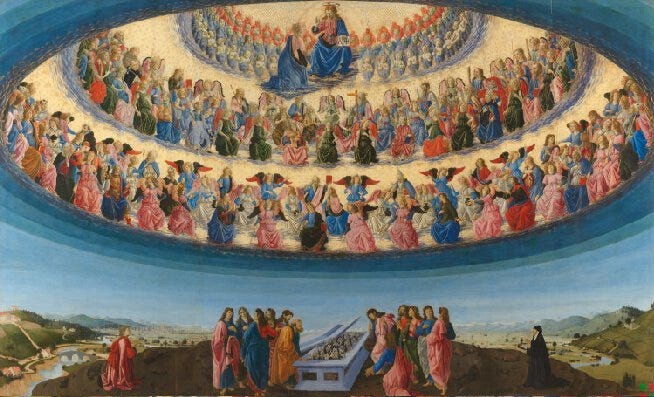
That is important because we have a duty to perform and a favour to call. It is our duty to pray for the faithful departed as they pass through purgatory to the pearly gates, so to speak - we help them in that way. And we have a favour in that we can call on the saints in heaven to pray for us, too, to help us in our sanctification process.
All of us in the Church Militant and the Church Penitent need prayers. The Church Triumphant are our friends and mentors to that end.
“But you have come to Mount Zion and to the city of the living God, heavenly Jerusalem, and to innumerable angels in festal gathering, and to the assembly of the first-born who are enrolled in heaven, and to the judge who is God of all, and to the spirits of the just men made perfect.” (Hebrews 12:22-23)
Praying for saintly intercessions is a practice shared by Roman Catholics, Orthodox Catholics and Anglican Catholics.
The Book of Revelation teaches us this, “And another angel came and stood at the altar with a golden censer; and he was given much incense to mingle with the prayers of all the saints upon the golden altar before the throne; and the smoke of the incense rose with the prayers of the saints from the hand of the angel before God.”
Does that undermine the idea that Christ is our one mediator? Of course not, because the Sacred Scriptures are inerrant and cannot contradict each other.
Jesus is indeed our mediator between us and God the Father. When we pray to the Saints, we are not replacing Christ or cutting Him out of the loop. We are asking the Saints to pray to the Lord for us as we pray to the Lord.
The overly cliched example is when you ask your friend or neighbour to pray for you, are you asking them to take the place of Jesus? Of course you are not. You are simply requesting more prayers to Jesus. The same can be said of our prayers to the Saints.
Occasionally, Protestants will try to rebuke catholics by saying things like the Old Testament warns against praying to the dead. Indeed, it does, but the New Testament fulfils the Old, and Christ communed with Elijah and Moses on the mountain at the Transfiguration to set a new way. Where the Old Testament warned against necromancy and sorcery, the New Testament teaches us how to properly petition our brethren in Christ through prayer.
When Jesus was resurrected from the dead, He opened the tombs – not just His, but the tombs of the Saints. The Gospels teach us that. In Matthew chapter 27, we read, “And behold, the curtain of the temple was torn in two, from top to bottom; and the earth shook, and the rocks were split; the tombs also were opened, and many bodies of the saints who had fallen asleep were raised, and coming out of the tombs after his resurrection they went into the holy city and appeared to many.”
And so, we know the Saints are not dead but risen in Christ.
As for purgatory, as well as what has been revealed to us through Sacred Tradition, there are also Biblical references to affirm this teaching. In 2 Maccabees we read of men who “turned to prayer beseeching that the sin which had been committed might be wholly blotted out… He also took up a collection… and sent it to Jerusalem to provide for a sin offering. In doing this he acted very well and honorably… Therefore he made atonement for the dead, that they might be delivered from their sin.” And in Matthew’s Gospel, we read, “And whoever says a word against the Son of man will be forgiven; but whoever speaks against the Holy Spirit will not be forgiven, either in this age or in the age to come.” The understanding in both cases is that sins can be forgiven after death, at least in some instances. Whilst unrepentant mortal sin eternally separates us from God, venial sin does not. Because of that, we always retain hope for the salvation of the dearly departed; this is why we always pray for the dead.
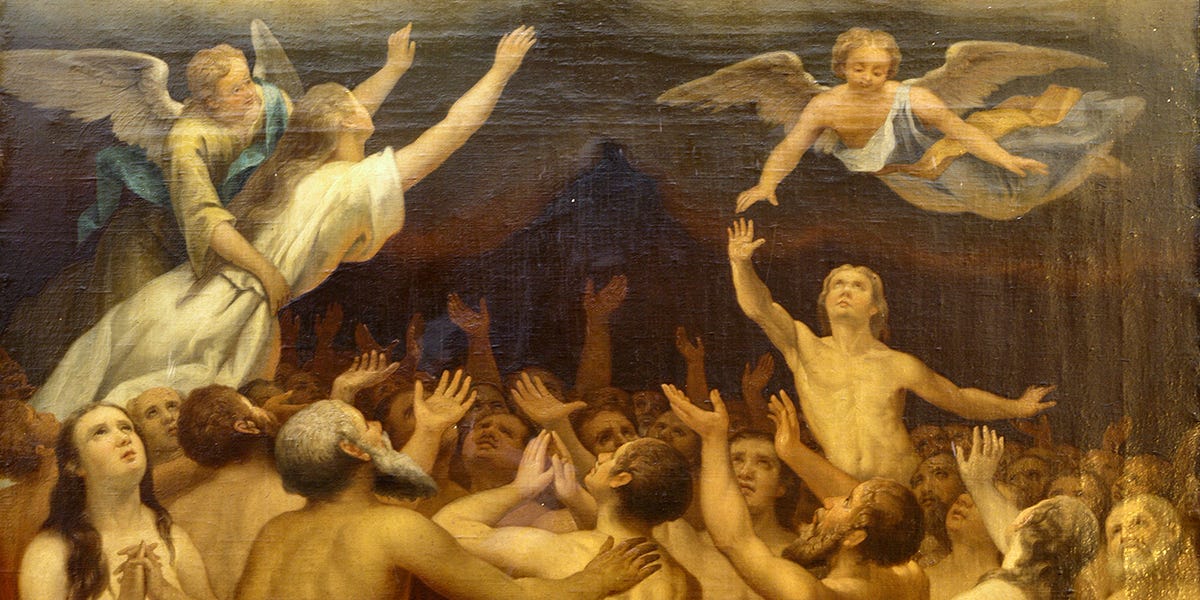
Other Scriptural references to purgatory can be found in Matthew 5:25-26 and 1 Corinthians 3:11-15, with very clear metaphors:
Make friends quickly with your accuser, while you are going with him to court, lest your accuser hand you over to the judge, and the judge to the guard, and you be put in prison; truly I say to you, you will never get out till you have paid the last penny.
For no other foundation can any one lay than that which is laid, which is Jesus Christ. Now if any one builds on the foundation with gold, silver, precious stones, wood, hay, stubble—each man’s work will become manifest; for the Day will disclose it, because it will be revealed with fire, and the fire will test what sort of work each one has done. If the work which any man has built on the foundation survives, he will receive a reward. If any man’s work is burned up, he will suffer loss, though he himself will be saved, but only as through fire.
Back to the Saints, who are they? In one sense, all of us. Another name for the Church – combining all three parts of it together – is the Communion of Saints. We hear this during the Canon of the Mass. The word ‘Saint’ comes from the Latin ‘Sancti’, meaning holy. Those who have been set apart, made holy, everyone baptised into Christ.
At the same time, the Saints in heaven partake in a greater fulness with Christ than we do, and so when we refer to ourselves, we tend to use small ‘s’ saints, and when we refer to the canonized (martyrs, confessors of the faith) Saints in heaven, we use capital ‘S’ Saints.
During Allhallowtide, we celebrate the saints here among us now and the Saints in heaven praying for us to join them.
One of the beauties of the Church catholic is that we can call upon Saints by name to intercede for us for specific purposes. For example, we refer to Saint Anthony as the patron saint of the lost – and so we can ask for his intercession when we are feeling lost or when we have lost something, for Him to put in a word with the big guy, which – in my humble experience – he has always been willing to do. And with my forgetful brain, I rely on St Anthony a lot.
There are many other Saints we can call on by name, and I recommend getting to know some of them through reading the Martyrology. You may notice I often post Collects in memorial of the Saint of the day on my X account.

It is an old Church tradition to assign a Saint’s name to a newborn child. When parents bring their baby to be baptised in the parish, they are given a saintly name – usually as a middle name, along with their Christian name – so that they have a patronal saint to look out for them, someone to build a relationship with on their journey toward Christ.
That is what it is all about: strengthening our relationship with God the Son and having helpers, friends, and mentors to guide us on our pathway toward Him.
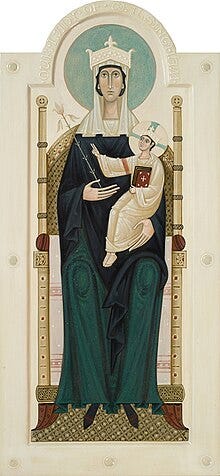
This is why many people rely on the intercession of Our Lady, the highest exalted amongst the Saints (“every generation shall call you blessed”). The Most Blessed Virgin Mary has the closest relationship with Christ of all who have lived or will live, and so we lean on her to help us find Him when we are feeling unworthy. She holds our hand, like the good mother that she is – mother to the whole Body of Christ – and she redirects us to her Son. Listen to Him, she tells us. Mary is not quoted very often in the Scriptures, but the words she is most famous for saying when she interceded for the wedding guests at Cana and insisted her Son perform His first miracle; she told His friends, “Do whatever He tells you”, and her advice is as prevalent today as it was 2,000 years ago.
Read the story of the 'Thief on the Cross' and ask yourself how he was saved. The thief was obviously a convicted criminal yet Jesus told him "TODAY you will be with me in paradise". Surely a convicted criminal would have to spend weeks, months or even years in purgatory! But that's not what the Bibles says. Also Jesus' death and resurrection pays 100% for your salvation. Your works, baptism, mass, church membership, purgatory etc etc it is as "filthy rags". It is ZERO%. Only Jesus' sacrifice can make a full and complete payment for your soul. Nothing else will do.
If the dead in Christ who are to be raised at Jesus' 2nd coming can hear our prayers then they can hear millions of people, praying in different languages, from different time zones all around the planet, they can understand these millions of prayers and they know how to respond, then they are gods!!! They are all-hearing, all-knowing, all-powerful and all-present. By your argument you're treating them as gods. God cannot be bribed because someone 'important' puts in an extra special word for us. Thee Creator God of the universe does not need 'help'. Treating God as if He needs intermediaries is blasphemous and a mockery of His Word.
I'm not saying these things without love. These issues are massively important. For the sake of your soul don't get this wrong just because you feel a particular religion is more comfortable or a better fit for your identity. Pray directly to Jesus and ask Him to show you the way. Relying on Jesus 100% is the only way to live and the only way to die. God Bless.
As an Anglo-Catholic, I find the defense of Purgatory puzzling, as it stands contrary to both Scripture and the witness of the early Church. The 39 Articles explicitly reject the doctrine, rightly stating that it is "vainly invented" and "repugnant to the Word of God." This aligns with the broader Catholic faith, which does not affirm Purgatory as the Roman Church does. The Orthodox, the Coptics, the Ethiopians, and other ancient branches of the Church all reject it, and it is notably absent from the writings of Clement, Ignatius, Justin Martyr, Athanasius, and even Augustine.
While I understand the Roman Catholic perspective of Purgatory as a penitential process of purification, it cannot be considered a truly universal doctrine of the Church when it lacks firm scriptural and patristic foundation and is held solely within the Roman tradition. However, I fully affirm the practice of praying for the dead and to the saints. God, who is not bound by time or the constraints of creation, hears our prayers as part of His eternal nature. These prayers are an expression of love, and God’s response to them transcends our temporal understanding.
It is our rejection of such "Romish" doctrines, including Purgatory as it is defined, that affirms our place as members of the broader Catholic Church in the Anglican tradition. We uphold the faith of the undivided Church, grounded in Scripture and the Creeds, without the later innovations of the Latin West.
I worry that embracing Purgatory signals a drift toward Rome, rather than remaining steadfast in the Anglo-Catholic understanding of the Church as part of the one, holy, catholic, and apostolic faith. As a High Churchman, I see great beauty in our Anglican identity, holding to the ancient traditions while rejecting what is unsupported by the earliest witness of the Church. This balance allows us to remain truly Catholic, without being Roman.